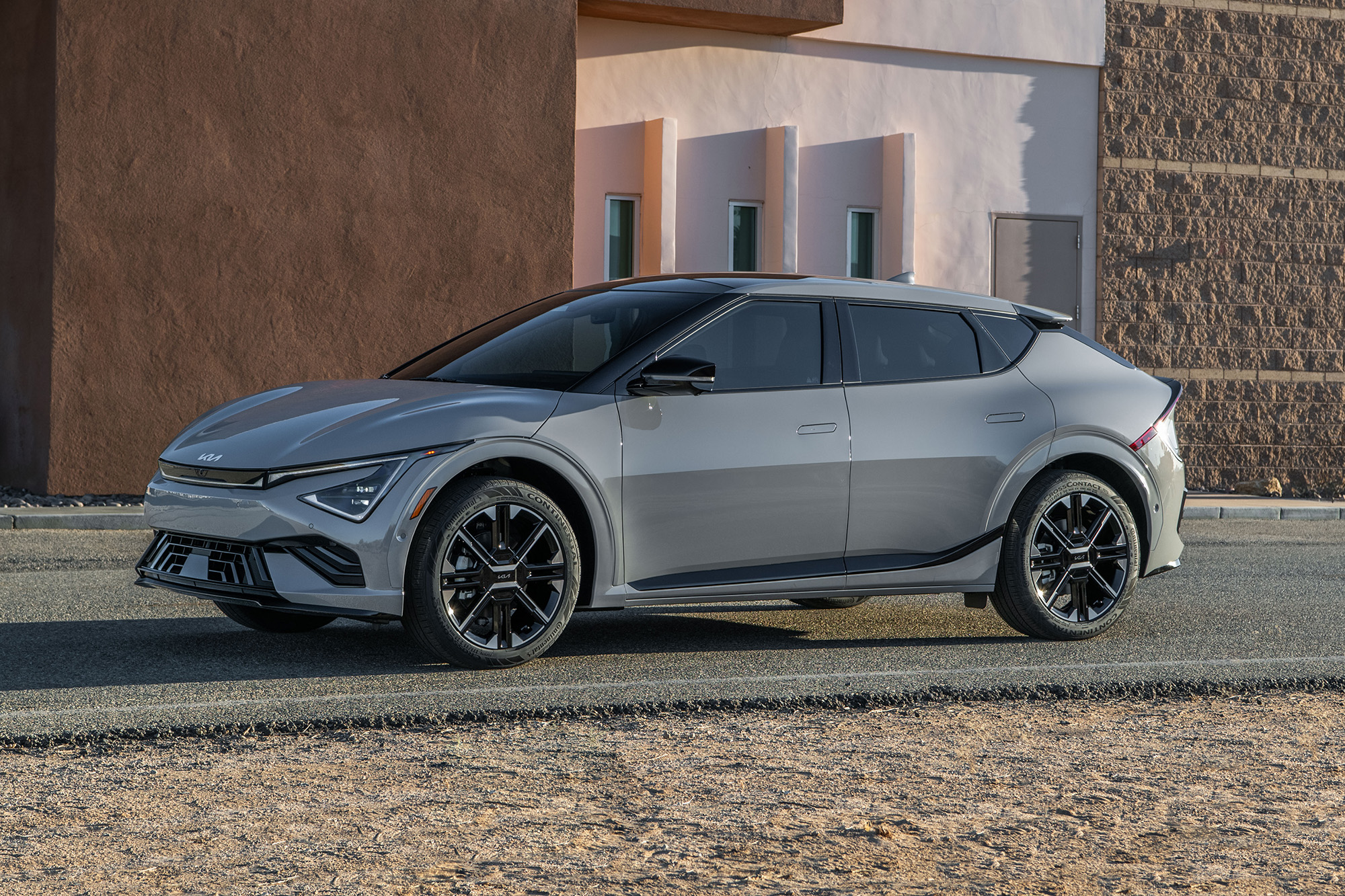
Kia EV6

  • Range after 3 years
  • Range after 5 years
  • 97% of original
  • 97% of original
Expected range based on over 1 billion miles of real world driving data from the
from the Recurrent community of EV owners.
Coming Soon
out of 5
Community Satisfaction
Kia's EV6 is a versatile and fun-to-drive electric crossover that offers configurations to meet diverse needs, from long-range models exceeding 300 miles (EPA) to performance-focused all-wheel-drive trims boasting up to 576 horsepower. Charging is among the fastest in the segment, with a 350-kW charger enabling 10% to 80% capacity in under 18 minutes. The EV6 is positioned as a strong competitor to rivals like the Ford Mustang Mach-E and Volkswagen ID.4.

Battery

Battery Warranty

10 yr / 100k miles

Time to add 100 miles

9 - 12 min

Peak Charging

180 – 240 kW

Efficiency

2.46 – 3.41 miles / kWh

MPGe

83 – 115 miles

Range

Range vs EPA

Higher

Winter Range (32°F)

79%

Summer Range  (90°F)

95%

Trims

GT

77.4 – 84.0 kWh

Light

58 – 84 kWh

Wind

77.4 – 84 kWh

Tips for Buying Used

The EV6 is built on Hyundai-Kia's E-GMP 800V architecture, the same platform underpinning the Hyundai Ioniq 5/6 and Genesis GV60. The most important reliability item to check is the Integrated Charging Control Unit (ICCU), the module that manages power flow between the high-voltage battery, the 12V system, and AC charging. Thermal and electrical stress could damage the ICCU and an associated high-voltage fuse, which can stop the unit from charging the 12V battery and lead to a loss of drive power. A NHTSA recall (which expanded an earlier 2024 action) covered roughly 62,000 2022-2024 EV6 vehicles; the fix is an ICCU/fuse inspection and replacement as needed plus improved thermal-management software. Confirm any used EV6 has had this recall remedy completed, and be aware some owners have reported repeat ICCU failures even after updates, so service-history documentation matters. Because the 12V battery depends on a healthy ICCU, a car with a neglected recall can also show 12V quirks like failure to wake or power up.

Match the trim and powertrain to your needs. Early US cars came as Light (smaller 58.0 kWh pack, RWD), and Wind and GT-Line (larger 77.4 kWh pack, RWD or AWD), with the high-performance GT arriving for 2023 on a dual-motor AWD setup. The smaller-pack Light is the value buy but gives up meaningful capability versus the larger-pack cars. AWD adds traction and power but costs some efficiency. The GT is quick but, by design, drops some comfort and convenience features (ventilated seats, power seat adjustment) found on lesser trims, so it is a different proposition rather than simply a higher-end EV6.

The 2025 model year is a meaningful dividing line. Refreshed cars moved most North American production to West Point, Georgia, grew the larger pack to 84 kWh, adopted a native Tesla-style NACS charge port (relocated to the driver's side), and updated the interior with a revised curved display, new steering wheel, and over-the-air update capability. GT trims continued to be built in Korea. Pre-2025 cars use a CCS port and will need an adapter for Tesla Superchargers. EV6 pricing has followed the broad used-EV depreciation trend, so well-equipped larger-pack cars can represent strong value used, but a Georgia-built 2025-plus car carries a different feature set that may justify the premium.

Model Years

2022 — US launch in Light, Wind, and GT-Line trims. Light used the smaller pack with RWD; Wind and GT-Line used the larger pack with RWD or AWD. CCS fast-charging on the 800V architecture, available augmented-reality head-up display, Highway Driving Assist, and vehicle-to-load (V2L) capability. Built in Korea.

2023 — The high-performance EV6 GT joined the lineup, a dual-motor AWD model with adaptive suspension and a drift mode, while giving up some comfort features. Trim structure and battery options otherwise carried over.

2024 — Largely a carryover year for trims and powertrains. This is the last model year of the pre-refresh design and the last covered by the 2022-2024 ICCU recall, so verify the remedy was performed.

2025 — Major mid-cycle refresh. Most North American production moved to West Point, Georgia; the larger battery grew to 84 kWh; the car gained a native NACS charge port relocated to the driver's side; and the interior was updated with a revised curved display, new steering wheel, fingerprint authentication, and over-the-air updates. GT models continued to be Korea-built. Georgia assembly made many trims eligible for federal EV incentives.

2026 — Continuation of the refreshed car with the 84 kWh pack and NACS port across the relevant trims; no major mechanical changes from the 2025 refresh.

How it Compares

The EV6 is a compact crossover, a low-slung five-seat hatchback-SUV that prioritizes driving feel and efficiency. The EV9 is a much larger three-row family SUV on a longer wheelbase, seating six or seven. Both share the E-GMP 800V platform and a lot of the same software, charging behavior, and the underlying ICCU hardware, so they feel related under the skin, but they serve different buyers: the EV6 for one or two people (or a small family) who want a sporty, space-efficient EV, and the EV9 for households that need a third row and maximum cargo.

Below the EV6 sit Kia's smaller electrics. The Niro EV is a more conventional, value-oriented subcompact crossover built on a shared platform with hybrid versions rather than the dedicated E-GMP architecture; it charges more slowly (400V system) and is less powerful, but it is practical and efficient. The Soul EV was an even earlier, boxy small EV with modest range, now effectively a legacy choice on the used market. The newer EV3 is a small dedicated electric crossover positioned beneath the EV6, giving Kia an entry-level E-GMP-class option. Against all of these, the EV6 offers more performance, faster 800V charging, and more advanced driver-assist and infotainment features, and it generally sits above them in price.

Compared with the EV9, the EV6 is less expensive, more efficient, and easier to park, but it cannot match the EV9's seating, cargo volume, or available captain's-chair second row. If you do not need three rows, the EV6 is usually the better value and the more engaging car to drive; if you regularly carry more than five people, the EV9 is the clear choice within Kia's lineup.

Owner Satisfaction

Coming Soon

Looking to Sell?

No games. No spam. No headaches. Just great offers for great electric cars.
Learn More

FAQ

Is the EV6 reliable, and what is the ICCU issue?

The EV6 is generally well-regarded, but the main known concern is the Integrated Charging Control Unit (ICCU), which can fail and cause loss of drive power. A NHTSA recall covered 2022-2024 EV6s with an inspection, replacement as needed, and updated software. Confirm the recall remedy was completed on any used car you consider.

Does the EV6 come with a long warranty?

Yes. Like other Kia models, the EV6 carries a 10-year/100,000-mile powertrain limited warranty and a separate 10-year/100,000-mile high-voltage battery warranty (for the original US purchaser), plus a 5-year/60,000-mile basic warranty. Note that some coverage terms transfer differently to second owners, so verify the remaining coverage for your specific car.

What should I inspect on a used EV6?

Confirm the ICCU recall has been completed and ask about any 12V battery or no-start issues. Check which battery the car has (the smaller pack on early Light trims versus the larger pack on Wind/GT-Line, or 84 kWh on 2025-plus cars) and whether it is RWD or AWD, since these affect performance and capability.

What should I inspect on a used EV6?

Light is the entry RWD model with the smaller battery; Wind and GT-Line add the larger pack and optional AWD plus more features; the GT is the dual-motor performance flagship that trades some comfort features for speed. The 2025 refresh also changed the charge port to NACS and moved most production to Georgia, which is worth factoring into a trim-versus-year decision.