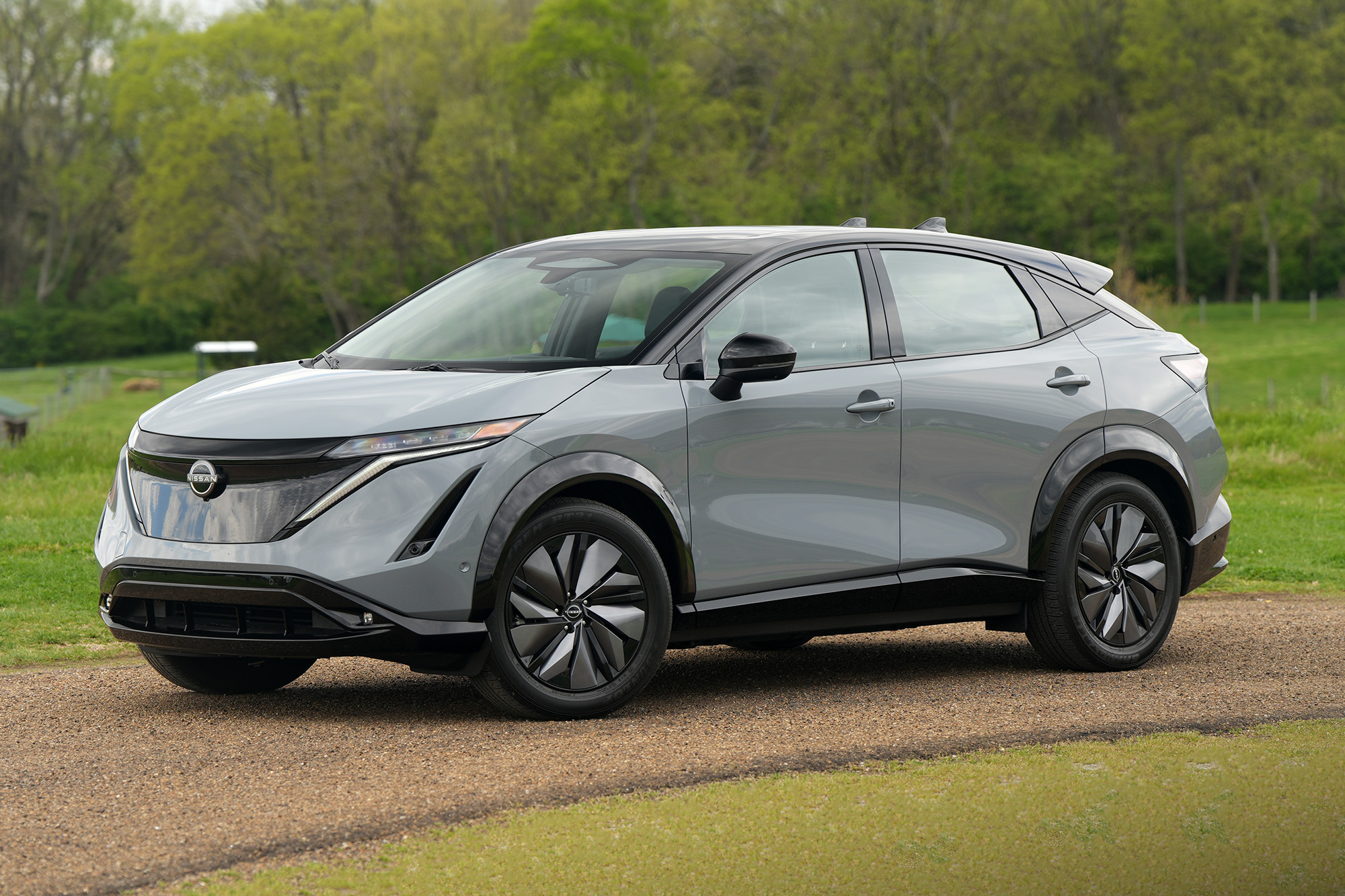
The Ariya is Nissan's modern electric crossover, launched as a 2023 model with US deliveries beginning in late 2022. Unlike the older Leaf, it uses a liquid-cooled battery with active thermal management, so heat-driven degradation is far less of a concern; a healthy used example should hold its capacity well. Two pack sizes were offered: a smaller 63 kWh battery (base trim only) and an 87 kWh battery on everything else. Drivetrains are either front-wheel drive or e-4ORCE dual-motor all-wheel drive. When shopping, confirm which battery and drivetrain a given car has, because trim names alone don't always make it obvious, and the difference materially affects capability.
Early production was the Ariya's biggest weak point. Supply-chain and chip constraints pushed the launch back and held 2023 volume well below plan, so early cars are relatively scarce and build quality and software maturity varied. There are two important documented recalls, both software-related and both fixable with a free dealer update: a 2023 recall for an inverter software issue that could cause a loss of drive power, and a 2024 recall for inverter software that could cut motor torque at high speed and drop the car into a fail-safe mode. Verify both have been completed via a VIN check before purchase, and confirm any infotainment/software updates have been applied, as early owners reported screen and connectivity quirks that later updates addressed.
Nissan suspended Ariya production for the US market, making 2025 the final model year here, with resources redirected toward the next-generation Leaf. That status tends to push used prices and depreciation in the buyer's favor, but it also means you should confirm local dealer service support and parts availability for your area. ProPILOT Assist is standard across the lineup, and the more capable ProPILOT Assist 2.0 (with hands-off capability on mapped highways) appears on higher trims, so check which system a specific car has if driver assistance matters to you.
2023 — First US model year; deliveries began late 2022. Offered with a smaller 63 kWh battery (base) or larger 87 kWh battery, in FWD or e-4ORCE AWD. Launch trims included Venture+, Evolve+, Empower+, and Premiere, with Platinum+ added later in the cycle. Production shortfalls made early cars scarce. Subject to a software recall for potential loss of drive power.
2024 — Carryover crossover with a broader, renamed trim walk (Engage, Venture+, Engage+, Evolve+, Empower+, Premiere, Platinum+ across FWD and e-4ORCE versions). The Engage base trim carries the smaller pack; other trims use the larger pack. Subject to a separate software recall addressing possible loss of motive power at high speed.
2025 — Final US model year before Nissan suspended Ariya production for this market. Largely a carryover of the 2024 car. Reallocation of resources toward the next-generation Leaf was cited as the reason.
Within Nissan's EV lineup, the Ariya is the larger, newer, and more premium offering, while the Leaf is the smaller, older, lower-tier vehicle. The Ariya is a crossover SUV with a roomier cabin, available all-wheel drive (e-4ORCE), and a more contemporary interior and technology suite; the Leaf is a compact hatchback that has been on sale since 2011 and reflects an earlier generation of EV engineering.
The most important technical difference for a used buyer is battery thermal management. The Ariya uses a liquid-cooled battery with active thermal management, which protects the pack from heat and supports more consistent performance and longevity. The Leaf uses a passively air-cooled battery with no liquid cooling, which makes it more vulnerable to heat-related degradation, especially in hot climates and on older cars. The two also differ on charging hardware: Ariyas use the widely supported CCS fast-charging standard, whereas the Leaf uses the older CHAdeMO standard, which is being phased out in North America.
In short, the Ariya sits above the Leaf as Nissan's flagship EV crossover, positioned as a step up in size, refinement, drivetrain options, and price tier. A shopper choosing between them is really choosing between a small, value-oriented hatchback and a larger family-oriented SUV.
Coming Soon

It is a relatively new model with two documented software-related recalls, both addressed by free dealer updates. The most important step is a VIN check to confirm those recalls (the 2023 inverter recall and the 2024 high-speed torque-cut recall) were completed. Mechanically the liquid-cooled battery is well-protected against heat, which is a positive for long-term durability.
Confirm whether the car has the smaller or larger battery and whether it is FWD or e-4ORCE AWD, since these vary by trim and affect capability. Verify that all recall and infotainment software updates have been applied, and test the touchscreen and connectivity, as early cars had software quirks that later updates resolved.
Yes. As a crossover SUV it offers more passenger and cargo room than the Leaf hatchback, a flat floor for a roomy cabin, and available all-wheel drive for varied weather. ProPILOT Assist driver aids are standard, with the more advanced ProPILOT Assist 2.0 on higher trims.
For used buyers it mostly affects supply and pricing rather than the car itself; 2025 was the final US model year. It is worth confirming local dealer service and parts support in your area, but the Ariya remains a conventional EV to own and service.