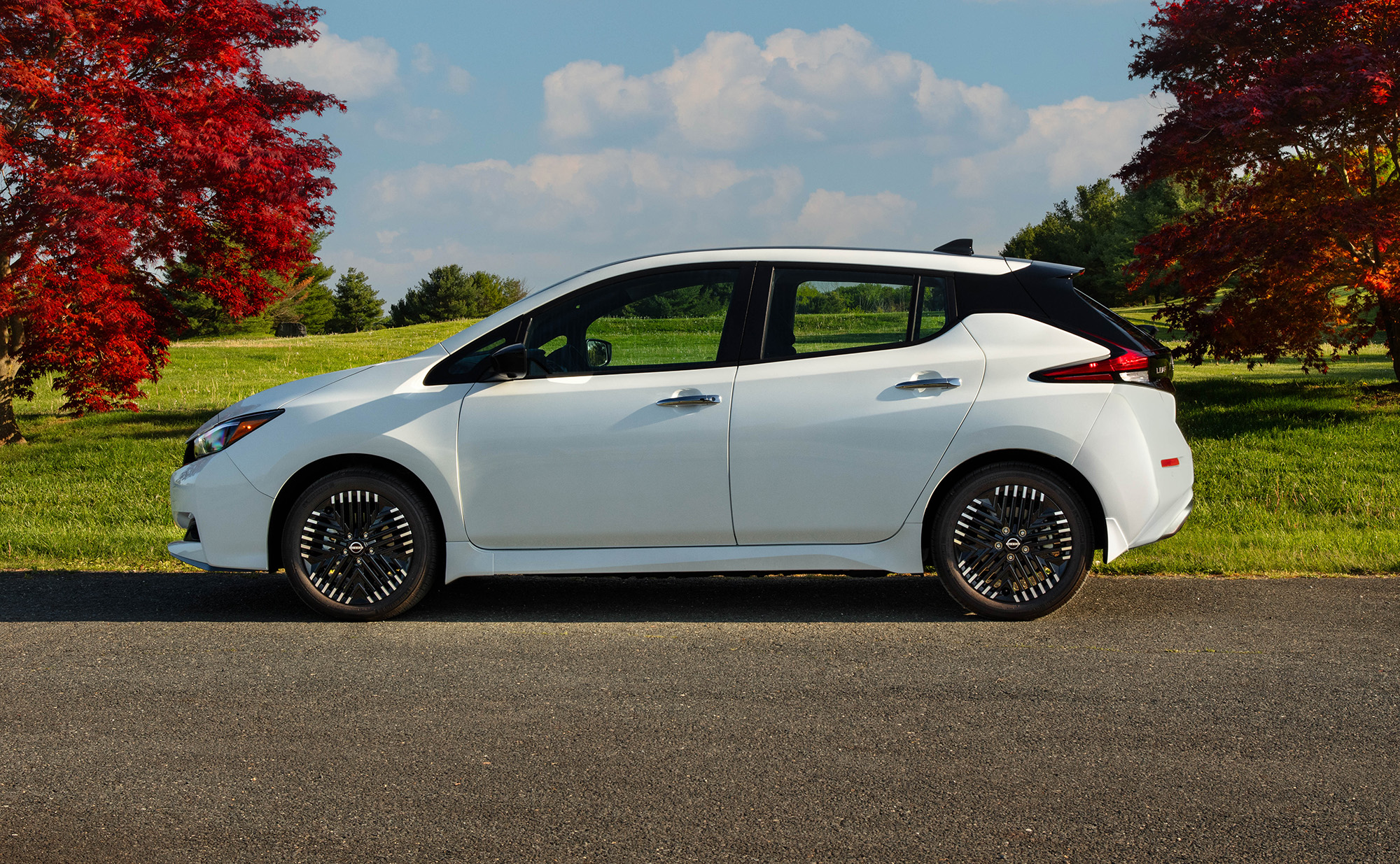
Nissan Leaf

  • Range after 3 years
  • Range after 5 years
  • 93% of original
  • 91% of original
Expected range based on over 1 billion miles of real world driving data from the
from the Recurrent community of EV owners.
4.5
out of 5
Community Satisfaction
Although technically predated by the Tesla Roadster, the Nissan LEAF is by many accounts the first commercially viable lithium-ion powered battery electric for sale in the US. With original purchase price around $30K, it allowed many drivers their first taste of the EV life. Used ranges for older models (2013-2018) are between 64 and 176 miles, while newer LEAFs all get at least 100 miles per charge. LEAF Plus, available from 2019 onwards, can get up to 280 miles on a charge, even used.

Battery

Battery Warranty

8 yr / 100k miles

Time to add 100 miles

43 min

Peak Charging

50kW

Efficiency

3.25 – 3.29 mi/kWh

MPGe

109.5 – 110.7 miles

Range

Range vs EPA

Higher

Winter Range (32°F)

78%

Summer Range  (90°F)

95%

Trims

Platinum Plus

75kWh

S

24 - 75 kWh

SL

24 - 62 kWh

SV

24 - 75 kWh

Tips for Buying Used

The single most important thing to understand about a used Leaf is its battery. Through every Gen 1 (2011-2017) and Gen 2 (2018-2024) model, the Leaf uses a passively air-cooled battery with no liquid thermal management. That makes heat-driven degradation a real and central buying consideration, especially on older cars and any car that has lived in a hot climate. Always evaluate the battery's remaining health rather than just mileage: the dashboard shows a "bars" capacity gauge (twelve bars when new), and losing bars indicates capacity loss. Gen 1 cars with the original 24 kWh pack (2011-2014) are the most degraded today; the 2015-and-later "lizard" battery used revised chemistry that tolerates heat better and holds up noticeably longer. The 30 kWh pack (2016-2017) is also known for degradation. Nissan's capacity warranty (covering loss below a defined bar threshold within a set time/mileage limit) is worth checking on any car still potentially within it.

Charging hardware is the other major used concern. Every Leaf through 2024 fast-charges via the CHAdeMO port, a standard that is now effectively orphaned in North America: networks have stopped installing new CHAdeMO connectors and the Leaf was the last mass-market CHAdeMO car sold here. For a used buyer this means public fast-charging options for a Leaf will keep shrinking, so it is best suited to owners who charge mostly at home. Separately, the 2018+ 40 kWh and 62 kWh cars exhibit "Rapidgate," where fast-charging speeds are throttled after repeated back-to-back DC fast charges because the air-cooled pack overheats and the software limits it to protect the battery.

Know the pack sizes when you shop: 24 kWh (2011-2015), 30 kWh (2016-2017), 40 kWh (2018+), and the 62 kWh Leaf Plus/e+ (2019+). On the recall side, 2018-2022 Leafs are subject to a documented backup-camera recall where the camera image can be lost, and certain 2023 cars have a brake-tube corrosion recall; verify both via a VIN check. Because the Leaf is being wound down in favor of a next-generation model, depreciation has been steep, which works in a used buyer's favor as long as you have factored in battery health and charging realities.

Model Years

2011 — First US model year (sold as a 2011), launched in select markets with a 24 kWh air-cooled battery in SV and SL trims. Among the first mass-market EVs in America.

2012 — Largely carryover 24 kWh car. Early 2011-2012 cars were later the subject of a battery-capacity class-action settlement that extended capacity warranty coverage.

2013 — US production moved to Smyrna, Tennessee, and a new lower-priced S base trim was added, dropping the entry price. Charging and efficiency improvements were also introduced.

2014 — Carryover 24 kWh car with minor changes across S, SV, and SL trims.

2015 — Introduced the revised "lizard" battery chemistry that better tolerates heat and resists degradation, while keeping the 24 kWh capacity.

2016 — Battery capacity increased on SV and SL trims to 30 kWh, raising range; the S trim retained the 24 kWh pack.

2017 — Final Gen 1 year; 30 kWh pack carried over on higher trims.

2018 — Full redesign launched the Gen 2 Leaf with a 40 kWh battery, new styling, and added technology including available ProPILOT Assist and standard e-Pedal one-pedal driving.

2019 — Added the Leaf Plus (e+) with a larger 62 kWh battery in S Plus, SV Plus, and SL Plus trims, alongside the 40 kWh S, SV, and SL.

2020 — Carryover Gen 2 lineup with 40 kWh and 62 kWh Plus options.

2021 — Carryover with trim and feature shuffling across the 40 kWh and 62 kWh lineup.

2022 — Simplified lineup; carryover 40 kWh and 62 kWh Plus models.

2023 — Facelifted Gen 2 with updated styling and a streamlined two-trim lineup (S 40 kWh and SV Plus 62 kWh); EPA range was slightly revised. Some 2023 cars are subject to a brake-tube recall.

2024 — Carryover of the facelifted Leaf, continuing the 40 kWh and 62 kWh Plus offerings and the CHAdeMO fast-charging port.

How it Compares

The Leaf is Nissan's original and smaller EV: a compact five-door hatchback that has been on sale since 2011. Compared with the Ariya, it is shorter, lighter, lower to the ground, and carries fewer passengers and less cargo. It sits in a lower price tier and reflects an earlier era of EV design, whereas the Ariya is the newer, larger crossover SUV that serves as Nissan's flagship electric vehicle.

The defining difference for a used buyer is battery engineering. The Leaf relies on a passively air-cooled pack with no liquid thermal management, which makes it more susceptible to heat-related degradation than the liquid-cooled, actively managed battery in the Ariya. The two also use different fast-charging standards: the Leaf uses the older CHAdeMO connector, now being phased out in North America, while the Ariya uses the broadly supported CCS standard. These are meaningful, practical distinctions, not just spec-sheet trivia.

Positioned against the rest of Nissan's lineup, the Leaf is the entry point to electric ownership: small, simple, value-oriented, and best suited to home charging and local driving. The Ariya is the step up in size, technology, drivetrain choice (including e-4ORCE all-wheel drive), and refinement. Shoppers cross-shopping the two are essentially deciding between a budget-friendly hatchback and a roomier family SUV.

Owner Satisfaction

Survey feedback from Recurrent's community of EV owners that includes a variety of model years and vehicle trims.

"It has lots of physical buttons and an analog speedometer. It feels like a traditional car, but also feels modern. Other EVs try to put everything on a touchscreen to make it feel futuristic but in reality simple things like physical buttons are a better user experience."
"Value. Leaf Plus has a ton of range and costs nearly nothing after tax credits and incentives."

Looking to Sell?

No games. No spam. No headaches. Just great offers for great electric cars.
Learn More

FAQ

How do I judge the battery health of a used Leaf?

Look at the capacity gauge on the dashboard, which shows up to twelve "bars" when the battery is new; missing bars indicate lost capacity. Because the Leaf has no liquid cooling, prioritize cars that lived in cooler climates and ask for the car's state-of-health reading. The 2015-and-later "lizard" battery generally holds up better than earlier 24 kWh packs.

Does the CHAdeMO charging port matter when buying a used Leaf?

Yes, it is worth understanding before you buy. Every Leaf through 2024 fast-charges with the CHAdeMO connector, a standard now being phased out in North America, so public DC fast-charging stations for it are becoming harder to find. A Leaf makes the most sense for a buyer who charges primarily at h

Is the Leaf a practical family or commuter car?

As a compact hatchback it works well as a commuter or second car, with a usable rear seat and a hatchback's flexible cargo area, but it is smaller than the Ariya crossover and less suited to large families or big loads. It is simple to live with and inexpensive to run, which is much of its appeal used.

Is the Leaf a practical family or commuter car?

Run a VIN check for the 2018-2022 backup-camera recall, where the rearview image can become distorted or blank, and the brake-tube corrosion recall affecting certain 2023 cars. Also be aware of "Rapidgate" on 2018+ 40 kWh and 62 kWh cars, where fast-charging speed is throttled after repeated DC fast charges because the air-cooled pack heats up.