Heading
Why are solid-state batteries taking so long to get commercialized?
The development timeline for solid state batteries (SSBs) actually aligns well with historical precedent. Consider that lithium-ion batteries took roughly 20 years to progress from laboratory concept to commercial production. SSBs, first formally discussed in research around 2011, are following a similar trajectory toward testing and production.
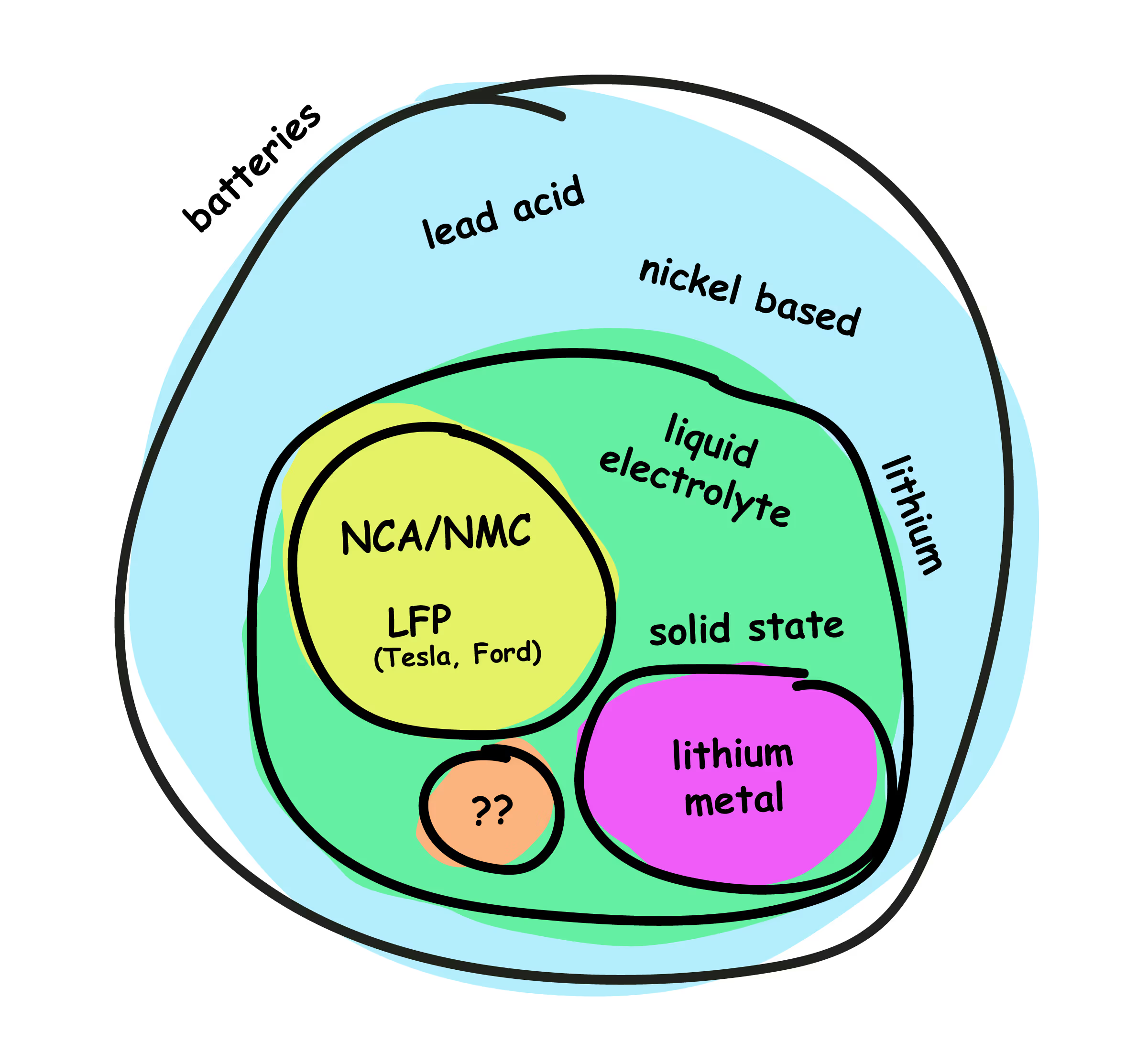
A major factor in the timeline is manufacturing infrastructure. SSBs require entirely new production facilities and processes - you can't simply retrofit existing plants. This challenge is compounded by current market dynamics: we're seeing an oversupply of lithium-ion batteries and growing investment in LFP technology, leading some to question whether we even need SSBs, given that current batteries already offer impressive safety and range.
What are some of the hurdles preventing SSBs from scaling up, and why have they been so difficult to overcome?
Two key hurdles stand out. First, rigorous testing and validation must verify that SSBs meet commercial standards for safety, longevity, and performance under real-world vehicle conditions. Second, costs remain significantly higher than lithium-ion batteries. This creates a classic chicken-and-egg scenario - thorough validation is essential before commercialization, profitability depends on achieving manufacturing scale. This is where automotive-battery company partnerships prove valuable, providing both a guaranteed customer and real-world testing environment. Laboratory success doesn't always translate to practical automotive applications.
Have we seen any breakthroughs that indicate real progress, or are we still in the theoretical stage?
In 2025, SSB technology went from theoretical to early real world deployment for semi-solid state batteries, with companies like Factorial in the US and NIO in China leading the charge. These batteries utilize gel electrolytes rather than liquid ones. This technology represents a middle ground - capturing some, but not all, of the advantages promised by true solid state batteries. Semi-solid state batteries offer improvements in energy density, performance, fast charging capabilities, and thermal safety compared to traditional lithium-ion batteries, though they don't quite reach the full potential of solid state technology. One key advantage is that they can be manufactured using existing facilities, making them a more mature and market-ready solution.
Mercedes-Benz & Factorial Energy - In February 2025, they integrated lithium-metal semi-solid-state batteries into a production EQS platform, the first car with solid-state batteries on the road for testing.
Stellantis & Factorial - Validated the same semi-solid-state automotive-sized cells in April 2025 that charge 15-90% in 18 minutes, operating from -30°C to 45°C. Demonstration fleet planned for 2026.
Semi-Solid Batteries Already in Production:
NIO - Already selling vehicles with 150 kWh semi-solid-state batteries (developed with WeLion) delivering up to 577 miles of range, compatible with existing models.
China Energy Storage - A 200 MW/800 MWh semi-solid-state battery energy storage station went online in November 2025 in Inner Mongolia using Qingtao Energy technology, achieving 12,000 cycle life.
Fully Solid State?
Donut Lab - Most dramatic breakthrough: They announced at CES 2026 the world's first production solid-state batteries already powering Verge Motorcycles in Q1 2026. The company says they charge in under 10 minutes and deliver 600km range on long-range versions. The battery world is eager to get their hands on production vehicles and see if the hype is real.
Refined Automaker Timelines for True Solid State:
Toyota - Received Japanese government production approval in October 2025. Plans 2026-2027 production start for Lexus flagship models. Claims 450-500 Wh/kg energy density, 10-minute charging, 1,200km range.
Nissan - Pilot production line operational, targeting fiscal year 2028-2029 for commercial EVs. Partnered with LiCAP Technologies for "dry electrode" process. Target: $75/kWh by 2028.
Samsung SDI - Promising 80% charge in 9 minutes by 2027.
Current State vs. Hype:
What's Real:
- Energy density: 350-360 Wh/kg semi-solid in production now; 400-500 Wh/kg targeted for full solid-state by 2027-2028
- Fast charging: 80% in 9-18 minutes demonstrated
- Safety: Operating temperature ranges vastly improved (-30°C to 45°C+)
- Production: Motorcycles, forklifts, and demonstration fleets already using them
What's Still Developing:
- Mass production cost competitiveness (still expensive)
- Large-scale automotive production (2027-2029 for most)
- Industry consensus: widespread commercialization before 2030 unlikely despite aggressive timeline
Is the technology primed to live up to the hype in terms of energy density, safety, and cost?
SSBs promise higher energy density, superior performance, better resilience to fast charging and heat-related degradation, and reduced thermal runaway risk. They will absolutely live up to the hype, but the need to get the first commercial one perfect may delay their release.
Read More:
Battery swapping: on the roadmap?