


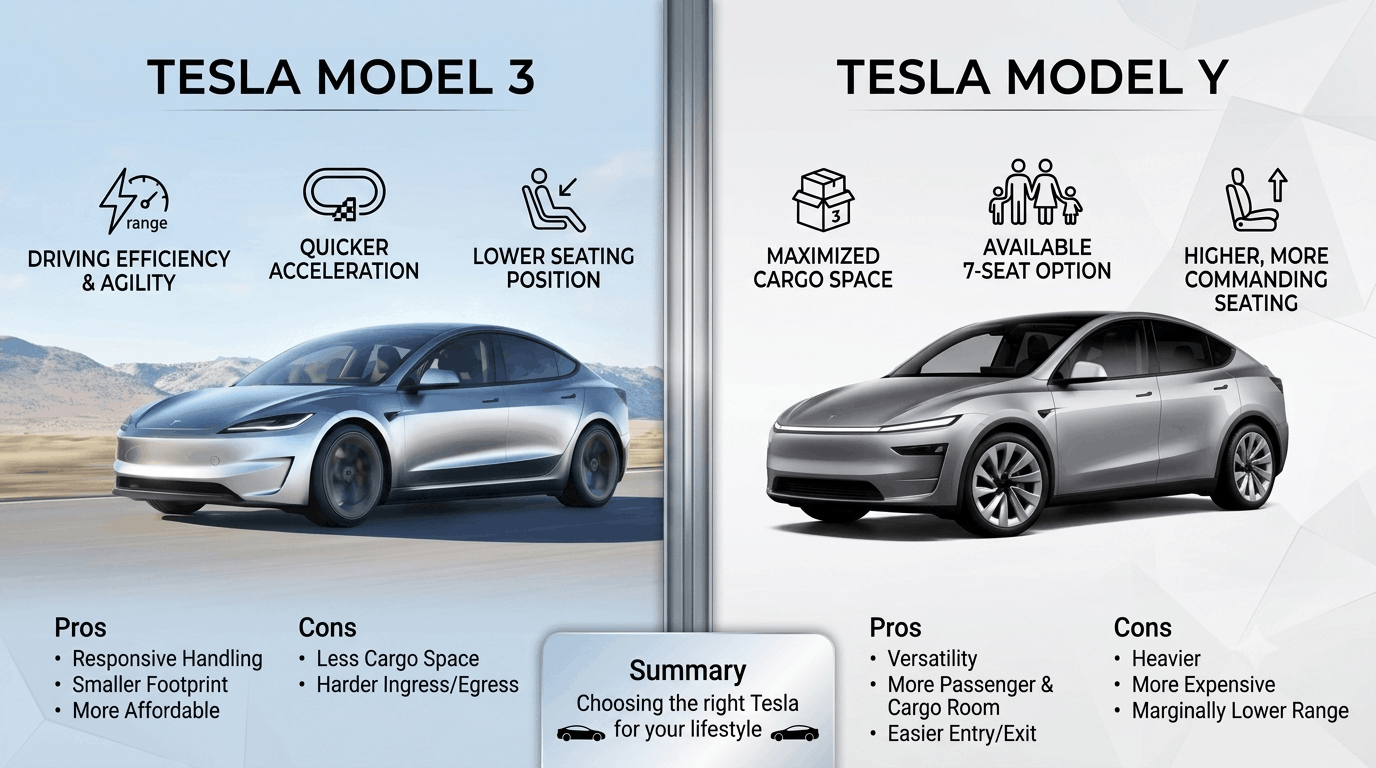


The Tesla Model 3 and Model Y are the two most-shopped used EVs in America. They share a platform, most of their interior, the same charging network, and a lot of their parts. So when you're choosing between them, the differences that actually decide it are narrow and specific: cargo space, ride height, real-world range, and price.
Model 3 vs. Model Y at a glance
The Model 3 is a sedan; the Model Y is a compact SUV built on the same bones. The Y is roughly two inches longer, about 1.6 inches wider, and sits around 1.3 inches higher off the ground. That extra size shows up where it counts: the Y has about five inches more rear legroom and far more cargo room, 34.3 cubic feet versus 22.9 in the five-seat configuration. Both seat five, though the Y has offered a seven-seat option in some model years.
The trade-offs run the other way. The Model 3 is lower and more aerodynamic, so it uses fewer kilowatt-hours per mile, and it's typically cheaper, both new and across most used model years.
The one-line version: the Model 3 is the cheaper, more efficient car. The Model Y is the roomier, more practical one that sits higher off the ground. Everything below is the detail behind that trade-off.
The short answer: Which should you buy?
A quick gut check before the detail:
- Buy the Model 3 if you want the lowest price (new or used) and the most range per dollar of electricity. It saves you money twice: on the purchase and on every mile you drive.
- Buy the Model Y if you regularly haul gear, kids, dogs, or bikes, or if a higher, more upright seating position matters to your back.
- The best used value on the market right now is a 2023 Model 3. More on why below.
If your life fits in a sedan, the Model 3 is the easy financial call. If you need the space, the Model Y's room and ride height earn the premium. Below, we show how big that premium runs by model year, because it's larger than most shoppers expect.
One owner's experience: Going from a Model 3 to a Model Y
The following is Andrew Leonard's firsthand account of switching from a Model 3 to a Model Y.
In early 2022, I was just a year into Model 3 ownership when we were hit by a driver running a red light. The car did its job: extra emergency braking, several saved angles of video evidence. Everyone walked away fine. The car itself was a total loss.
With a chance to buy again, I shopped for a Model Y. It had actually been my first choice originally, but early in its production run I wasn't impressed with the build quality on a test drive, so we'd gone with a tried-and-true Model 3 instead. By 2022, the Y had matured into a much more polished vehicle.
The Y turned out to be an excellent upgrade for my household, for a few concrete reasons.
Cargo space. This is the headline difference. The Y is only about two inches longer than the 3, but it's 1.6 inches wider and sits 1.3 inches higher. Rear-seat legroom jumps about five inches, and cargo volume goes from 22.9 to 34.3 cubic feet on the five-seat version. In practice, I can now fit a collapsed e-Bike and an intact road bike in the back with the seats down, plus luggage in the under-floor bins and the front trunk (the "frunk").
Ride height and comfort. This one surprised me. The Y uses the same seats as the 3, but they're mounted several inches higher, which creates a more upright seating position. I went from getting back pain after about an hour of driving to comfortably doing three-plus hours. The trade-off is that you feel like you're riding "on" the car instead of "in" it — a deal I'll happily take.
The little things. The upgraded Ryzen infotainment chip made the touchscreen and navigation noticeably snappier, and the jump from a Long Range Model 3 to a Performance Y added real power. The bigger cabin lets in slightly more road noise, but not enough to bother me.
Those family-friendly traits — space, ride height, ease of use — are exactly why the Model Y became Tesla's best-selling vehicle. If you're cross-shopping, drive both.
Real-world range: what these cars actually deliver
EPA range is a lab figure. Recurrent collects range data from a large community of real drivers, and the consistent pattern is that both cars deliver somewhat less than their sticker in everyday driving. That's normal for any EV and worth planning around.
Two points matter for the choice.
The Model 3 is the more efficient car. It's lower, smaller, and more aerodynamic than the Model Y, so it uses fewer kilowatt-hours per mile. If your priority is the most miles per dollar of electricity, or the most range from a given battery, the 3 has the edge across comparable trims. The Model Y trades some of that efficiency for its extra size and height.
Newer isn't automatically longer-range. Early performance data shows 2026 models meeting their EPA range expectations slightly less often than the prior model year, though not by enough to be a concern. So if you're cross-shopping a leftover 2025 against a new 2026, don't assume the newer car goes farther in the real world. Check the specific trim.
To see the real-world range for the exact trim and model year you're considering, Recurrent tracks it by vehicle. That's the number to trust over the window sticker.
Used prices: how big is the Model Y premium really?
We looked at 14,106 unique used EV listings, deduplicated from roughly 63,700 raw dealer listings with plug-in hybrids filtered out, live in spring 2026. Tesla alone makes up about 53% of the entire used EV market by listing count. The Model 3 and Model Y are, by a wide margin, the two most liquid used EVs you can buy.
Here's the median used asking price for each by model year, and how much more the Y commands over the equivalent 3:
- 2021: Model 3 around $23,800, Model Y around $27,600. A premium of roughly $3,800 (16%).
- 2022: Model 3 around $27,000, Model Y around $30,600. A premium of roughly $3,600 (13%).
- 2023: Model 3 around $27,000, Model Y around $33,600. A premium of roughly $6,600 (24%), the widest gap of any year.
- 2025: Model 3 around $39,100, Model Y around $41,000. A premium of under $2,000 (about 5%).
A few things stand out:
- The 2023 Model 3 is the value sweet spot. At roughly $27,000 with about 37,000 miles, a 2023 Model 3 costs about the same as a 2022. Depreciation has done most of its work, and you're getting a nearly current-generation car for the price. It's the single best price-to-newness combination on this list.
- The Y premium is widest on 2023 cars. That $6,600 (24%) gap is the most it ever costs to step up from the 3 to the Y. If you want a Y but the budget is tight, 2023 is the year the SUV upgrade hurts most.
- The premium shrinks on newer cars. By 2025 the gap narrows to under $2,000, as both cars cluster near the price floors set by Tesla's new-vehicle pricing. On a 2025, the Y upgrade is relatively cheap.
For trim shoppers on the high-volume 2023 model year: used 2023 Model 3s are mostly base/Standard trims (around $26,350 median), with Long Range near $31,590 and Performance near $33,990. Used 2023 Model Ys are overwhelmingly Long Range (around $32,990 median), with Performance near $34,990.
How fast do they sell?
Both cars move quickly. In our spring 2026 snapshot, the median used Model 3 listing turns in about 21 days and the Model Y in about 19, right around the broader used-EV median. Clean examples priced fairly don't sit on lots. If you find the right one, it won't wait two weeks for you to think it over.
So, Model 3 or Model Y?
The honest answer is that you can't go wrong. Same platform, same charging, same software. Two questions break the tie:
- Do you regularly haul people or cargo? If yes, the Model Y's extra space and higher seating are worth paying for. If no, the Model 3 saves you money on both the purchase and every mile you drive.
- What model year fits your budget? A 2023 Model 3 is the standout used value. If you've got your heart set on a Y, a 2025 carries the smallest premium over the equivalent 3.
Drive both if you can. Then let your cargo needs and your budget make the call, not the badge.
Curious what your current EV is worth before you trade up? Check your EV's value with Recurrent.


